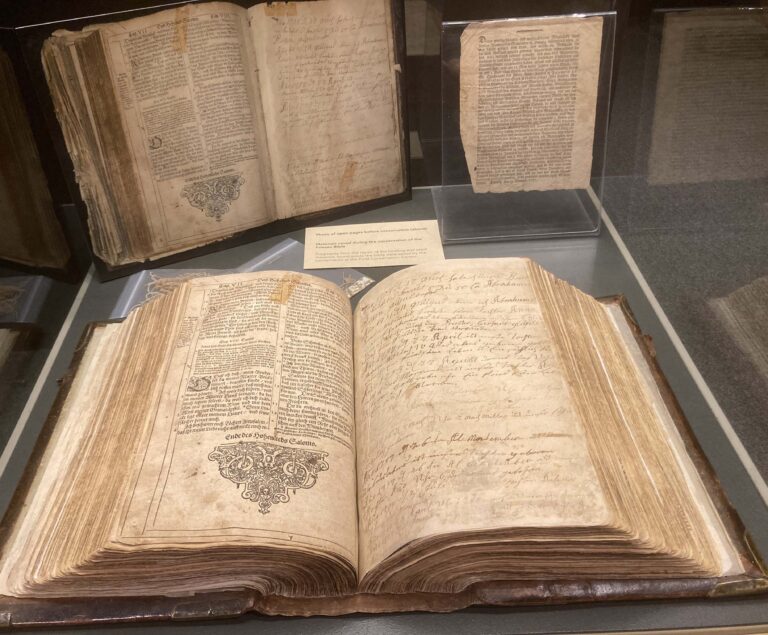
Two rare items with ties to Ukraine – a commemorative medallion and 17th-century Bible – can be seen at Kauffman Museum at Bethel College during the holidays.
These two important Mennonite artifacts returned to the college this fall after being in Nebraska for preservation treatment.
The 1630 German-language Friesen family Bible is normally kept at the Mennonite Library and Archives on campus. The medallion, one of only three made, is in the museum’s collection and commemorates Mennonite relief work in Ukraine in the early 20th century.
Both were at the Ford Conservation Center at the Nebraska State Historical Society in Omaha.
Kauffman Museum is open during the holidays, except for Christmas Day and New Year’s Day (the museum is always closed on Monday). Open hours include 9 a.m.-1 p.m. on Christmas Eve and New Year’s Eve, 9:30 a.m.-4:30 p.m. on non-holiday weekdays, and 1:30-4:30 p.m. on weekends.
The Bible and the medallion are in a display case near the Museum Store, just inside the museum’s front entrance. There is no admission charge to view them.
The Bible was in poor condition after three centuries of use that included travel in Europe and North America. Professional treatment at the Ford Center included cleaning, repair and restoration.
The medallion, which had become corroded, was cleaned, stabilized and protected from further deterioration.
The Friesen Bible, which includes the Old and New Testaments and the Apocrypha, was printed in Strasbourg (now France) in 1630.
Its history is unknown for the next 163 years, says John Thiesen, archivist at the MLA. According to notes found in the Bible, in 1793, Abraham von Riesen bought it for 5 rubles and 50 kopeks at Neuendorf, in the Chortitza Mennonite colony in southern Ukraine.
The Bible passed through several generations of von Riesen descendants and was inherited by the late Jake T. Friesen of North Newton, Abraham’s great-great-great-grandson.
The Bible also has ties to Mountain Lake, Minn., and southern Manitoba, where it was on display at a historical museum for several years.
One of Friesen’s children organized other Friesen descendants to finance the preservation and restoration of the Bible.
Thiesen pointed out one interesting tidbit about the Bible: when it came to the MLA, inside was a piece of paper that turned out to be a 1787 flyer from the Russian government, probably distributed when Mennonites were living in Danzig (Gdansk) in what is now Poland, to encourage them to migrate to Ukraine.
“This is the only known copy of this flyer still in existence,” Thiesen said.
Like the Friesen Bible, the medallion is connected to the Chortitza Mennonite colony – it was a gift to a delegation of Mennonite Central Committee (MCC) leaders in 1922 from recipients of MCC food and relief aid in the colony.
Mennonite artist John P. Klassen created three medallions from melted-down lead bullets dug from walls and found on the streets in Chortitza villages, the result of violence during the Russian civil war of 1918-20.
The museum’s medallion was originally given to MCC delegation member Christian E. Krehbiel. A second one went to P.C. Hiebert and is now on display at Tabor College, Hillsboro. The location of the third one is unknown.
Lisa Weaver wrote a children’s book in 2014, Swords into Plowshares: The Creation of John P. Klassen’s Mennonite Central Committee Medallion, that is for sale in the Museum Store.
Admission to the current Kauffman Museum special exhibit, “Voices of Conscience: Peace Witness in the Great War,” and the permanent exhibits – “Of Land and People,” “Mirror of the Martyrs” and “Mennonite Immigrant Furniture” – is $5 for adults, $3 for children ages 6-16, and free to Kauffman Museum members and children under 6. The museum store is open during regular museum hours. See kauffmanmuseum.org or the museum Facebook page for more information.